
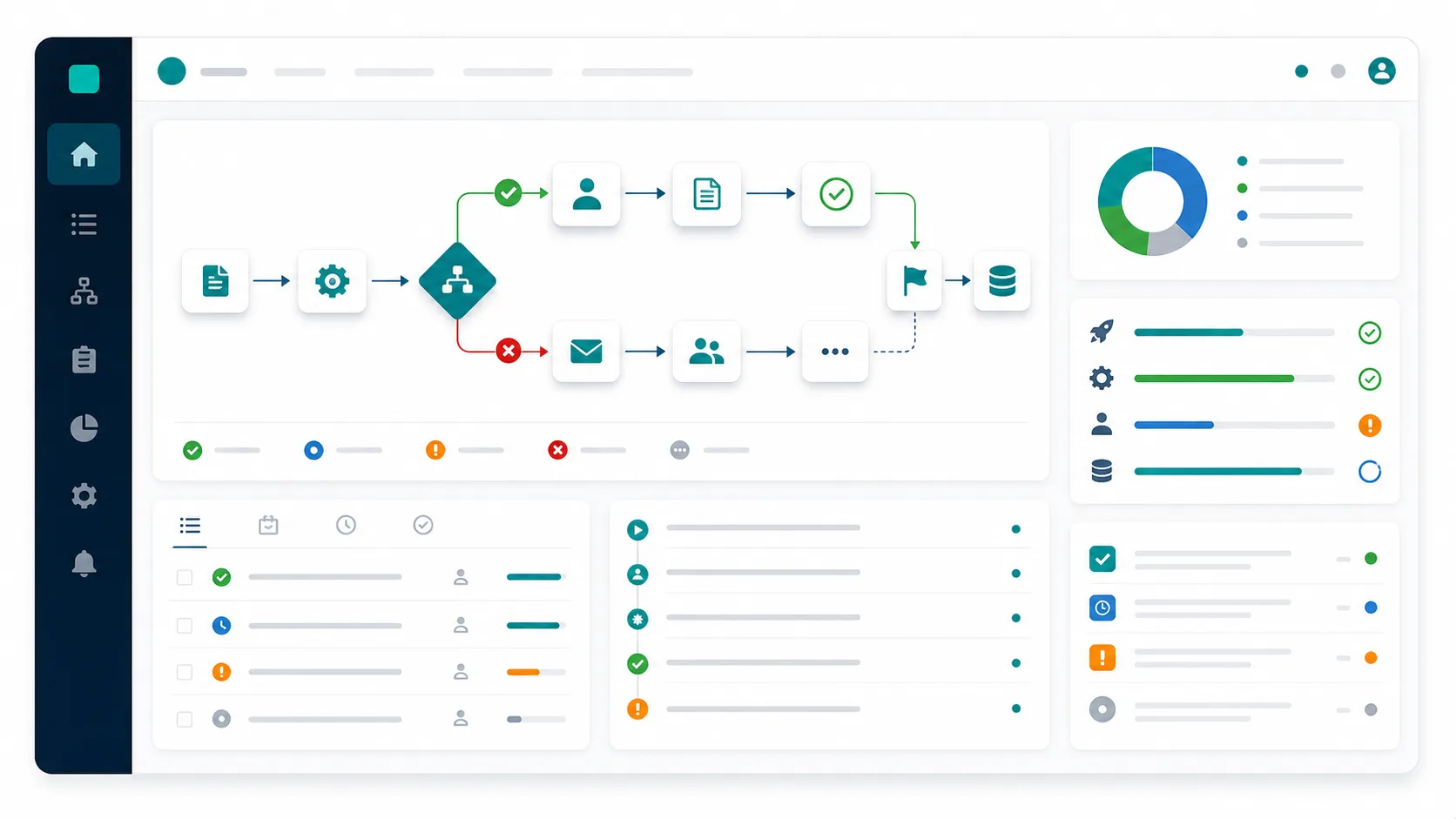
AI creates value when it is supported by clear processes, reliable data and connected systems. If a company automates on top of duplicated spreadsheets, changing criteria or information scattered across applications, the result is usually more friction: outputs that are hard to audit, teams that do not trust the system and exceptions that return to email.
Key idea: before discussing models, define which data owns the process, who decides and which exception needs human review.
The first task is not choosing a model. It is understanding how decisions are made and how information moves. You need to identify which data enters the process, who validates it, which system is the source of truth and what happens when something fails.
Map before automating
A useful operational map connects ERP, ecommerce, CRM, warehouse, finance, customer support and reporting. It does not have to become a heavy audit, but it should make duplicated information, manual checks and critical decisions visible.
From there, teams can prioritize limited use cases: request classification, draft generation, document extraction, data reconciliation or anomaly alerts. AI should enter where it improves a decision or removes repetitive work, not where it creates an opaque dependency.
Design controls from the start
AI automation needs traceability. Each run should keep input, output, rule version, related user and review reason when a human intervenes. For critical workflows, the best pattern is often a combination of deterministic rules and AI: rules block obvious errors while the model helps with natural language, incomplete context or varied documents.
Permissions also matter. A system that interprets an email does not need to modify invoices. A system that summarizes a document should not publish a response without validation. Separating reading, suggesting and executing reduces risk.
Useful references
The OpenAI developer documentation is a good starting point for model integrations. The NIST AI Risk Management Framework and OWASP Top 10 for LLM Applications help translate AI into concrete controls: logs, permissions, human review, testing and recovery.
At Codefuente we usually start with contained automations, connected to existing systems and measured with clear metrics. If the first case proves savings, quality and control, the next one arrives with less uncertainty.