
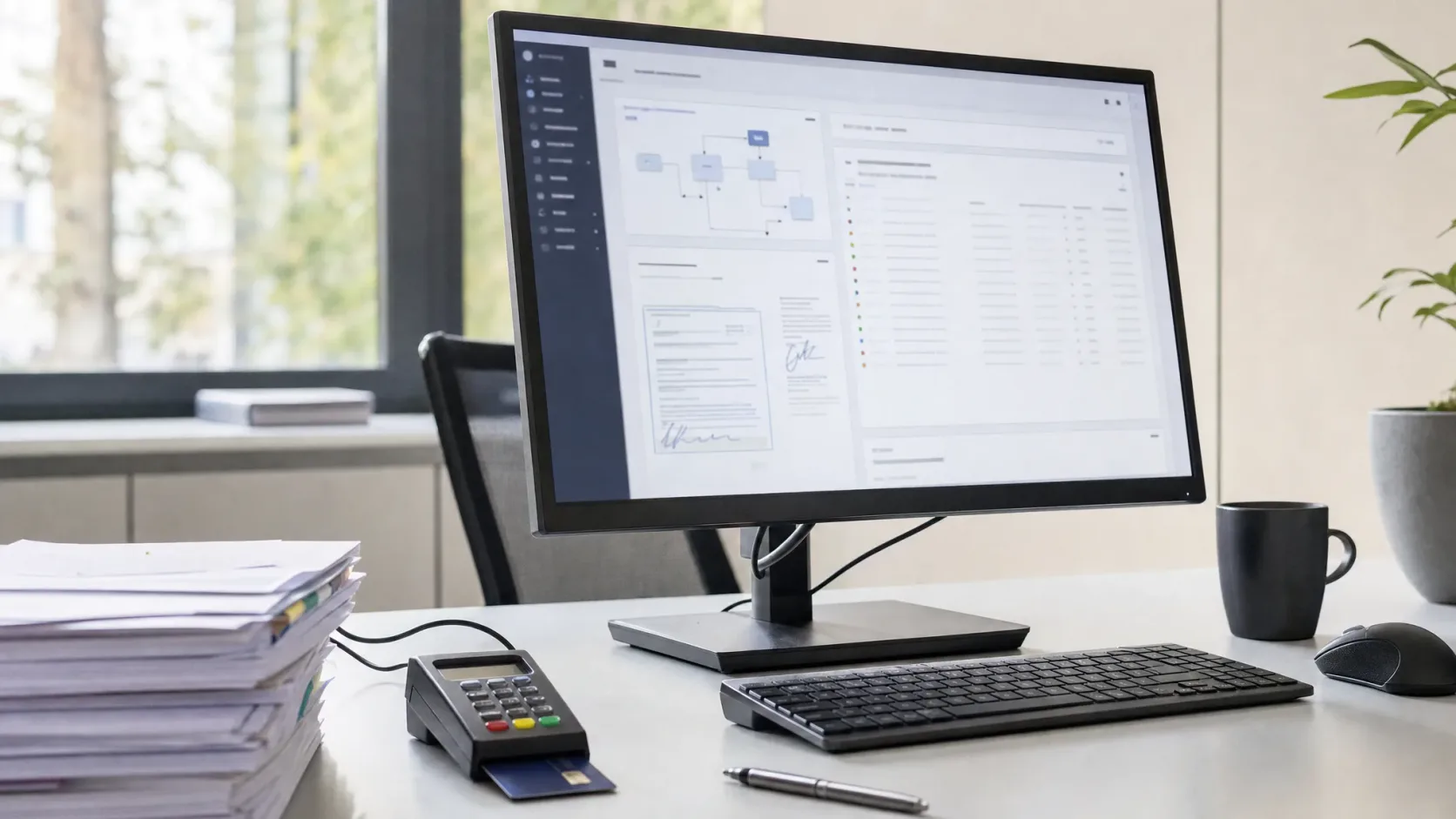
A familiar scene in many SMEs: the customer has agreed, procurement wants to close the supplier, and legal is still waiting on a signature that depends on three emails and a PDF forwarded for the fifth time. At that point, the problem is not “lack of technology”. It is that signing sits outside the workflow where the work is actually decided.
The important change is not faster signing; it is deciding which process no longer depends on email.
What Odoo actually announced
Odoo published, on 30 September 2026, a partnership with itsme to bring qualified electronic signatures to businesses. The announcement appears in Odoo News, the official primary source, and Odoo also highlights it on its blog as a business-oriented signing capability. (odoo.com)
What we can verify is the announcement itself and its business framing. What we should not assume is that every function is already available everywhere, for every customer, country or plan, without checking the product documentation and availability details. The point of the news is that it adds a new capability to the document flow, not that it replaces every signing setup overnight. (odoo.com)
Why this matters on a Monday morning
Qualified signatures affect more than compliance. In a small or mid-sized company, signing is rarely an isolated act. It is usually the final step in a chain: proposal, commercial approval, conditions review, filing and execution. If the signature happens outside the system, someone must copy data, resend versions and manually confirm which document is the right one.
Think of it like a conveyor belt in a warehouse. If one box leaves the line so someone can carry it by hand, the whole line slows down even if the box is light. Signing is often that box.
The business consequence is straightforward: less friction in contracts, purchase orders, onboarding, approvals and internal authorizations. And fewer “it’s waiting to be signed” excuses, which usually hide a lack of visibility and traceability.
Mini-scenario: when signing blocks more than price
Picture a distributor with two people in administration and a sales team closing deals by phone and email. Every month, several orders are delayed because the acceptance document goes through a manual review-and-sign sequence. Nobody is arguing about price; the bottleneck sits in the last few meters.
In that setting, an integrated Odoo signing flow can reduce the time between “yes” and “order in motion”. But there is a condition: the process must be designed properly. If each department keeps its own copy of the document, digital signing only speeds up the chaos.
So the useful decision is not to buy a feature. It is to map the circuit: who approves, what gets signed, when the document is locked and where evidence is stored.
The uncomfortable part: not every document should be treated the same
Here is the awkward truth. Many companies want to digitize everything, but not every document deserves the same level of rigor. A simple commercial quote does not need the same friction as an employment contract, a data processing agreement or a regulated document.
The temptation is to make qualified signing the universal answer. That is a mistake. The stricter the process, the easier it is for teams to bypass it with informal workarounds if it does not fit daily operations.
The better decision is to classify documents by risk, legal weight and frequency of use. That lets the strongest signature method handle what truly needs it, without slowing down minor tasks.
What decision this announcement enables
This announcement opens a concrete discussion: which documents still live outside the ERP, and why? If the answer is “because we have always done it that way”, there is likely room to simplify.
It also pushes leaders to think about integration, not just adoption. A signing tool that does not connect with sales, purchasing or administration ends up as an elegant island.
Three actions for this week
- List the documents currently signed by email or PDF and mark the ones that cause recurring delays.
- Pick one high-volume, low-risk process and test whether integrated signing reduces operational back-and-forth.
- Ask who keeps the proof of signature, where it is archived and who can audit it without help.
If you want that signing circuit to work inside Odoo without adding another manual layer, Codefuente usually starts with the process, not the tool.