
Applying AI in a traditional business starts with one repetitive task, the information it needs and a supervised trial. Once that works, connect it to the next department. You can begin while your company still uses spreadsheets and email.
Imagine a window manufacturer with 35 employees. Enquiries arrive by email, quotations live in Excel, purchasing has another spreadsheet and the workshop uses printed instructions. Answering a customer’s question means calling three colleagues. This is a fictional example, used throughout this guide; the same approach can fit construction or distribution.
A useful first result is entering an order once and giving everyone a reliable view of its status.
Your route through this guide
- Map today’s workflow.
- Choose one bottleneck.
- Prepare data and business rules.
- Run a supervised pilot.
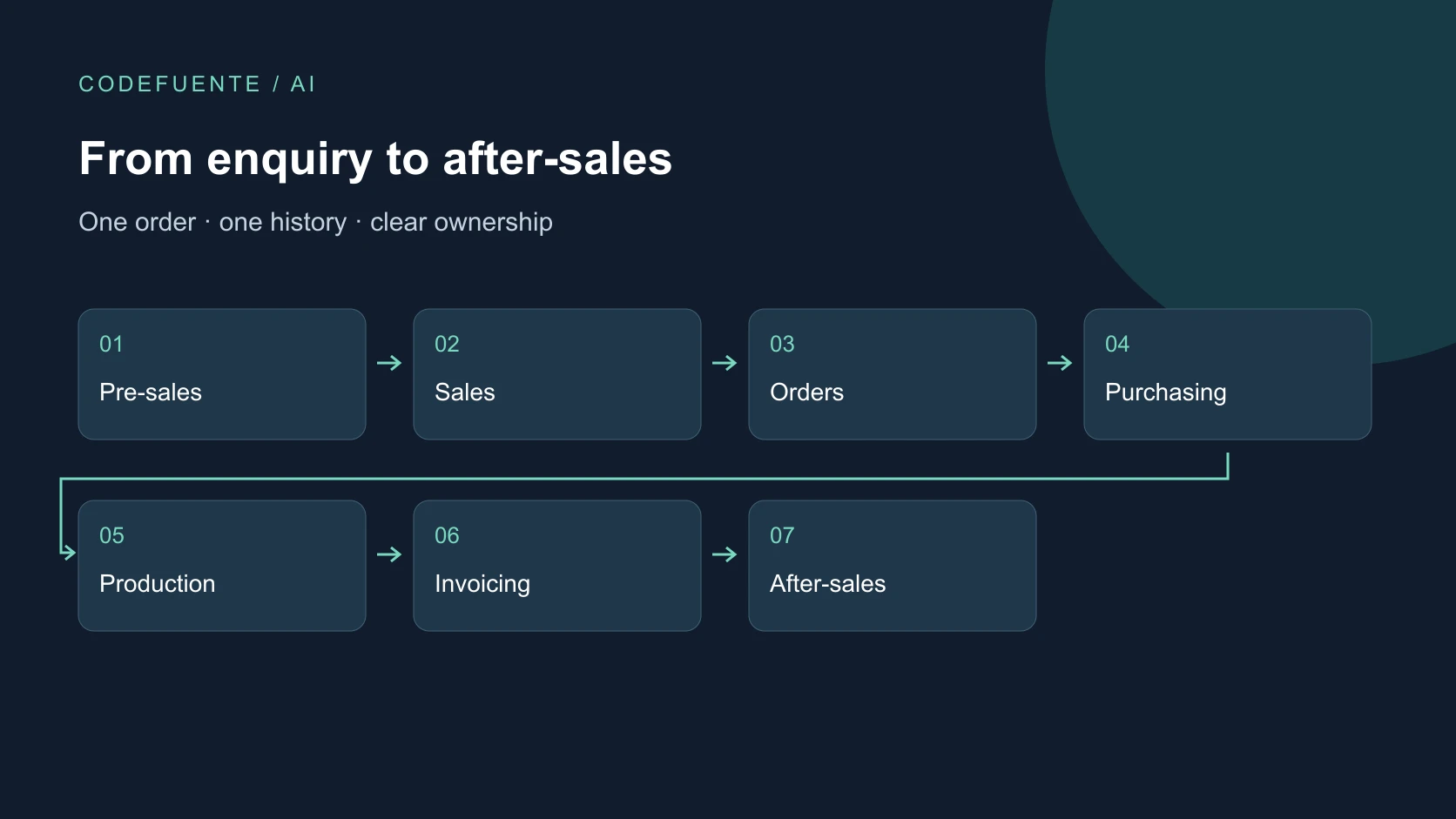
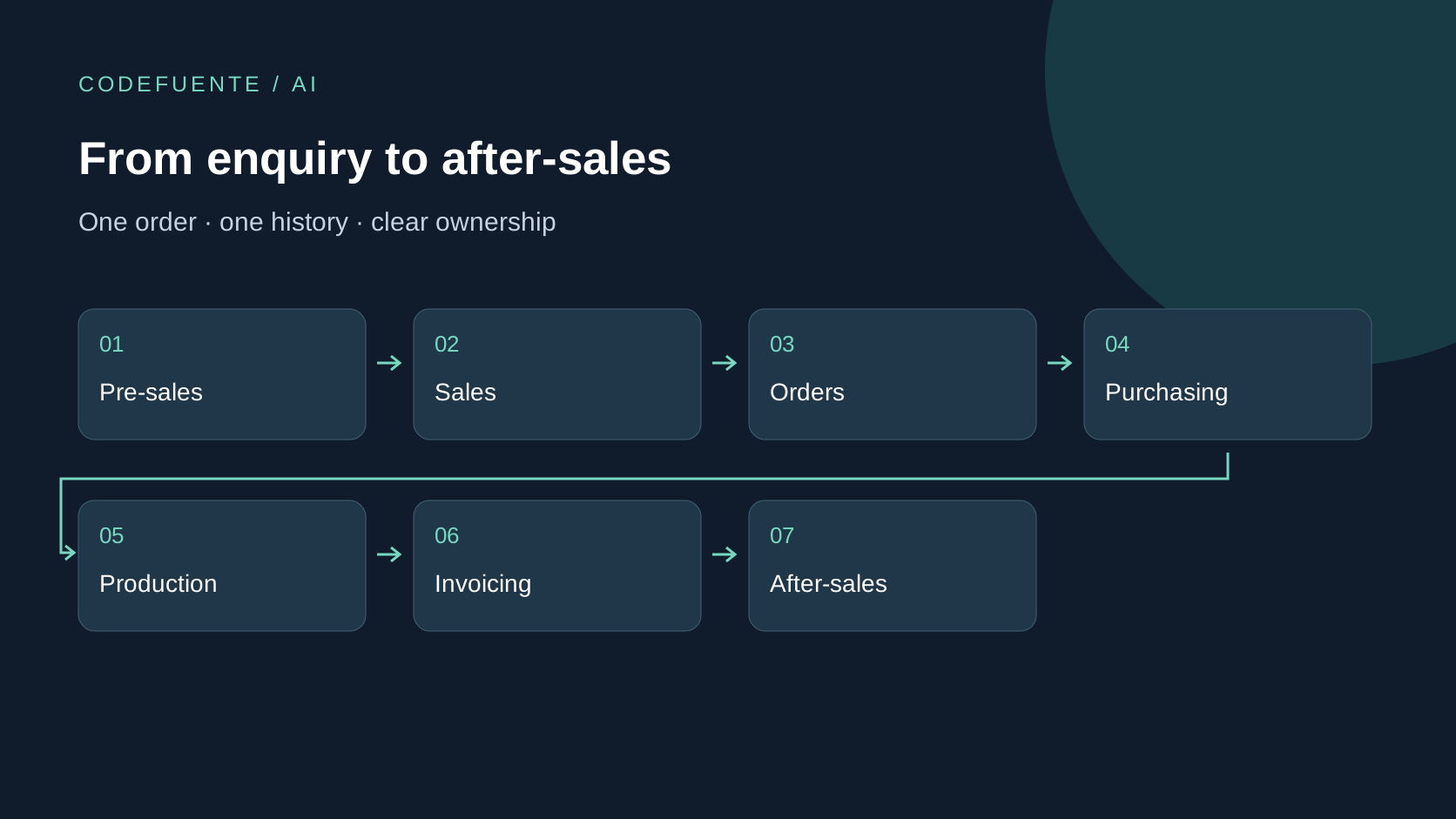
- Connect pre-sales, sales, orders, purchasing and production.
- Include invoicing and after-sales.
- Measure the result before expanding.
1. Follow a real order from enquiry to payment
Bring together someone from sales, purchasing, production and administration. Follow one recent order. Record what each person received, what they copied and what they had to ask someone else. Include calls and messages: these often explain the gaps in the spreadsheets.
Our manufacturer receives an enquiry for 20 windows. After the quotation, the customer changes the finish. Sales updates its spreadsheet, but purchasing keeps the previous version. Production uses the wrong specification. AI alone cannot resolve that coordination problem.
Start with one order identifier and a current approved version. A well-managed shared register may be enough initially. As dependencies grow, an ERP—a system for managing sales, purchases, inventory and invoicing—can provide a common foundation. You do not need every module on day one.
2. Choose a small task that causes daily friction
Look for frequent work whose output someone can check easily. Reading enquiries and preparing drafts are often more manageable pilots than scheduling an entire factory.
| Current task | Possible AI assistance | Human decision |
|---|---|---|
| Read prospective customers’ emails | Classify enquiries and extract requirements | Whether the opportunity fits and what is missing |
| Prepare a quotation | Draft text using approved catalogue information | Price, margin and delivery commitment |
| Enter a PDF order | Suggest order lines and flag ambiguity | Accept the order and approve changes |
| Compare supplier offers | Organise units, materials, terms and lead times | Select supplier and authorise purchase |
| Process workshop notes | Turn notes into structured reports | Confirm quantities, defects and causes |
| Review invoices | Extract fields and flag document discrepancies | Approve exceptions and payments |
| Handle a complaint | Retrieve context and draft a reply | Warranty decision, compensation and resolution |
Pick one row. Our manufacturer starts with quotation enquiries because sales can review each result before anything reaches a customer.
3. Prepare the data and separate three different tools
Collect a current catalogue, representative enquiries and an approved quotation template. Define required fields: customer, product, dimensions, quantity, finish, delivery location and requested date. Missing information should remain explicitly unconfirmed.
AI interprets variable information: an email, an unfamiliar document layout or a handwritten note transcribed with permission. Business rules calculate and validate: quantities, approved prices, required fields and limits. Integrations move approved information: from quotation to order, then to purchasing and production.
Use formulas or business software for monetary calculations. If a structured form already provides every required field, conventional automation may be enough.
Name the person responsible for maintaining the catalogue and rules. Begin with fictional or anonymised examples. Before using internal information, check the provider’s terms, access permissions, retention and deletion options.
4. Run a pilot before allowing actions
For example, choose 30 representative enquiries: clear, incomplete, with attachments and with later amendments. This is a starting suggestion rather than a statistically guaranteed sample. Keep some examples aside to evaluate the finished configuration.
Ask for fields and supporting evidence. A trial instruction could be:
Read this enquiry. Prepare product, dimensions, quantity, finish and requested date. Show the sentence supporting each field. If information is absent, write “awaiting confirmation”. Do not invent prices or promise delivery dates. Draft questions for the sales team to review.
The prompt describes the task. Permissions and software validation enforce the limits. During the pilot, the assistant prepares drafts without permission to send offers or change orders.
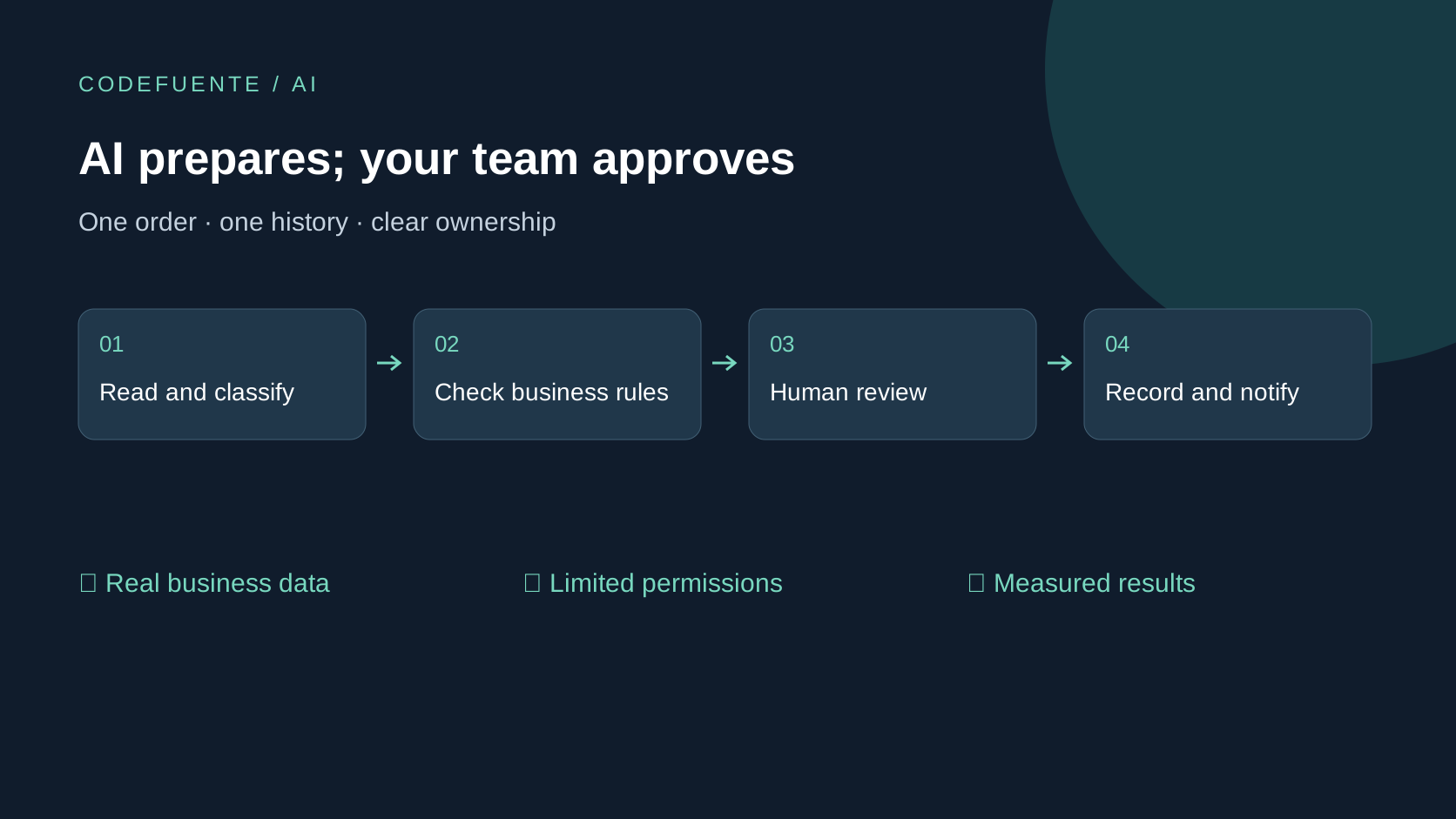
Test awkward cases too: conflicting quantities, an old attachment or instructions inside a customer document that contradict your rules. Treat document contents as input data. Ambiguous cases should reach a person with the original evidence attached.
5. Connect the handoffs between departments
Pre-sales to sales. AI prepares the enquiry record and missing-information questions. Sales checks the opportunity and quotation draft. Prices come from the approved catalogue; calculations use defined rules.
Sales to orders. After customer acceptance, an integration creates the order from the approved quotation. Record the approved version and acceptance. A later finish change becomes an amendment that purchasing and production must assess before a new promise is made.
Orders to purchasing. Business software calculates materials using maintained rules. AI can compare descriptions and summarise supplier conditions. Purchasing checks equivalence, quantities and units before approval.
Purchasing to production. The workshop receives current specifications and a confirmed target. AI can summarise production incidents and draft an alert. The planner decides whether to change the sequence after checking actual capacity.
Give each handoff a clear status, timestamp and owner. Reuse the same identifier when an automation retries, and record completed actions so a retry cannot create a second order.
6. Include invoicing and after-sales
Administration needs visibility of completed and outstanding deliveries. AI can extract document fields and highlight discrepancies. Invoicing software applies configured accounting rules and calculations. Missing delivery evidence should follow your agreed exception process.
For a complaint, retrieve the order, approved version, delivery and incident history. AI can prepare a sourced summary and draft reply. If warranty evidence is missing, send the case to the responsible person.
A useful notification says: “Order 184: finish awaiting confirmation; sales owns the next action; purchasing is blocked.” A generic incident alert forces everyone to investigate again.
7. Measure the whole task, including corrections
Compare today’s handling time with the pilot. Include reading, review, correction, recording, discarded drafts and duplicate work.
Hypothetical calculation: 100 enquiries a month at 15 minutes each take 25 hours. At 7 minutes including review, they take approximately 11.7 hours, leaving a potential difference of 13.3 hours. That is recovered capacity, whose value depends on how it is used. Tools, maintenance and training still cost money. These are illustrative figures, not measured Codefuente results or a savings guarantee.
Set continuation criteria beforehand: less total handling time, no unapproved customer commitments and fewer enquiries returned for missing information. If corrections consume the saving, adjust the pilot before expanding.
A four-week starting plan
- Week 1: trace an order, select a task, measure the baseline and name a pilot owner.
- Week 2: prepare examples, catalogue, required fields and review criteria with the people doing the work.
- Week 3: test drafts alongside the manual process and record errors and correction time.
- Week 4: decide whether to stop, improve or connect the next step. Teach the team how to correct results and resume the manual procedure.
This is an indicative sequence. Team availability and data complexity determine the actual schedule.
Adapting the approach to construction or distribution
In construction, an enquiry may become a project brief and a workshop report becomes a site report. AI could summarise visits, propose extracted measurements and collect incidents for the site manager. Measurements and technical decisions still need professional validation.
In distribution, start with availability enquiries, product-reference matching or partial-delivery complaints. AI interprets the message; the inventory system supplies actual stock and dates.
Both use the same pattern: shared information, a bounded task, review and a dependable handoff.
Turn AI videos into a practical business question
The Inteligencia Artificial channel is one starting point for discovering tools and discussion. When watching a demonstration, ask which business task it could help, what data it requires and who would check the result. A demonstration does not validate performance on your documents.
The NIST AI Risk Management Framework provides a public reference for organising risk assessment. This guide is our practical starting proposal, rather than a certified implementation of that framework.
Codefuente connects business AI, automation and integrations. To identify a first pilot, tell us where work gets stuck: what arrives, who reviews it and what the next department needs.