
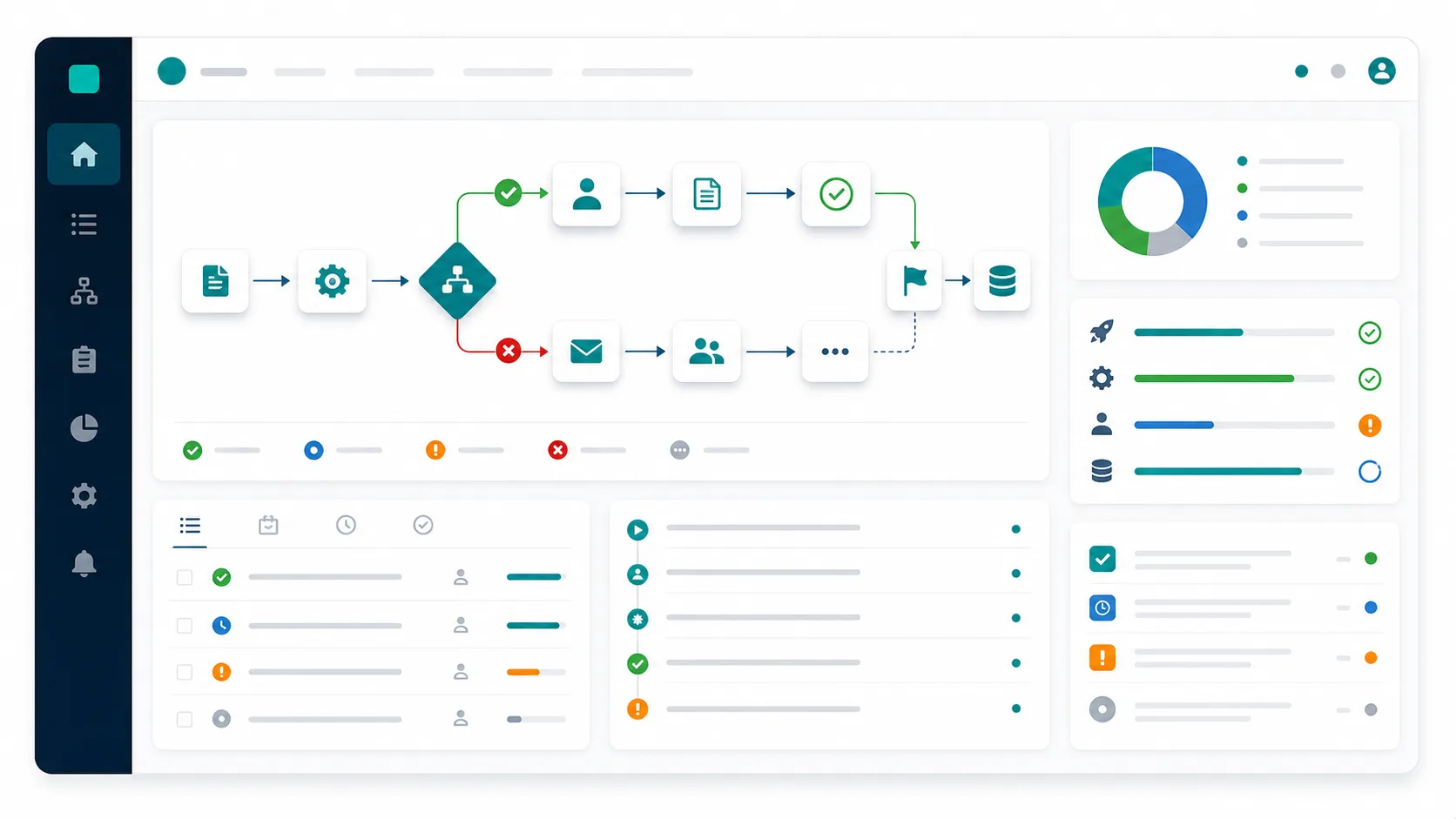
Automation should not hide what is happening. A good automation leaves traces, allows decisions to be reviewed, manages exceptions and offers clear points for human intervention. This is especially important when AI is involved, because getting a useful answer most of the time is not enough: teams need to know when to trust, when to review and how to correct.
Controlled automation means every run can be explained, measured and corrected without relying on intuition.
The best workflows usually combine three layers. The first is explicit business rules: validations, limits, states, owners and permissions. The second is integration with the systems that hold real data. The third is AI, which helps interpret text, classify cases, extract information or suggest actions.
What to automate first
Start with repetitive tasks that have enough volume and controlled risk. Examples include classifying support emails, drafting responses, reading commercial documents, reviewing incomplete fields, detecting orders with incidents or preparing operational summaries.
These cases can be measured before and after: response time, avoided tasks, reduced errors and number of human reviews. Without metrics, automation is just a feeling; with metrics, the team can decide whether to scale, adjust or stop.
Integrations and auditability
AI should rarely work alone. It needs to query ERP, CRM, ecommerce, warehouse or internal systems, and it also needs to write results in a controlled way. APIs, queues, webhooks and reconciliation processes are part of the design. A useful automation records each step: which data it received, which rule it applied, which output it generated and which user approved or corrected it.
For critical processes, a simple architecture can be more robust than an ambitious one. A workflow that creates a pending task and suggests an action may be better than one that modifies data automatically without supervision.
Recommended references
The OpenAI documentation is useful for model integration patterns. For application security around AI, OWASP LLM Top 10 highlights common risks. For connected business systems, documenting API contracts with OpenAPI improves maintenance, testing and coordination.
The key is to treat AI as one part of the company’s operating system, not as a shortcut. If the process is traced, measured and connected, automation can grow without losing control.