
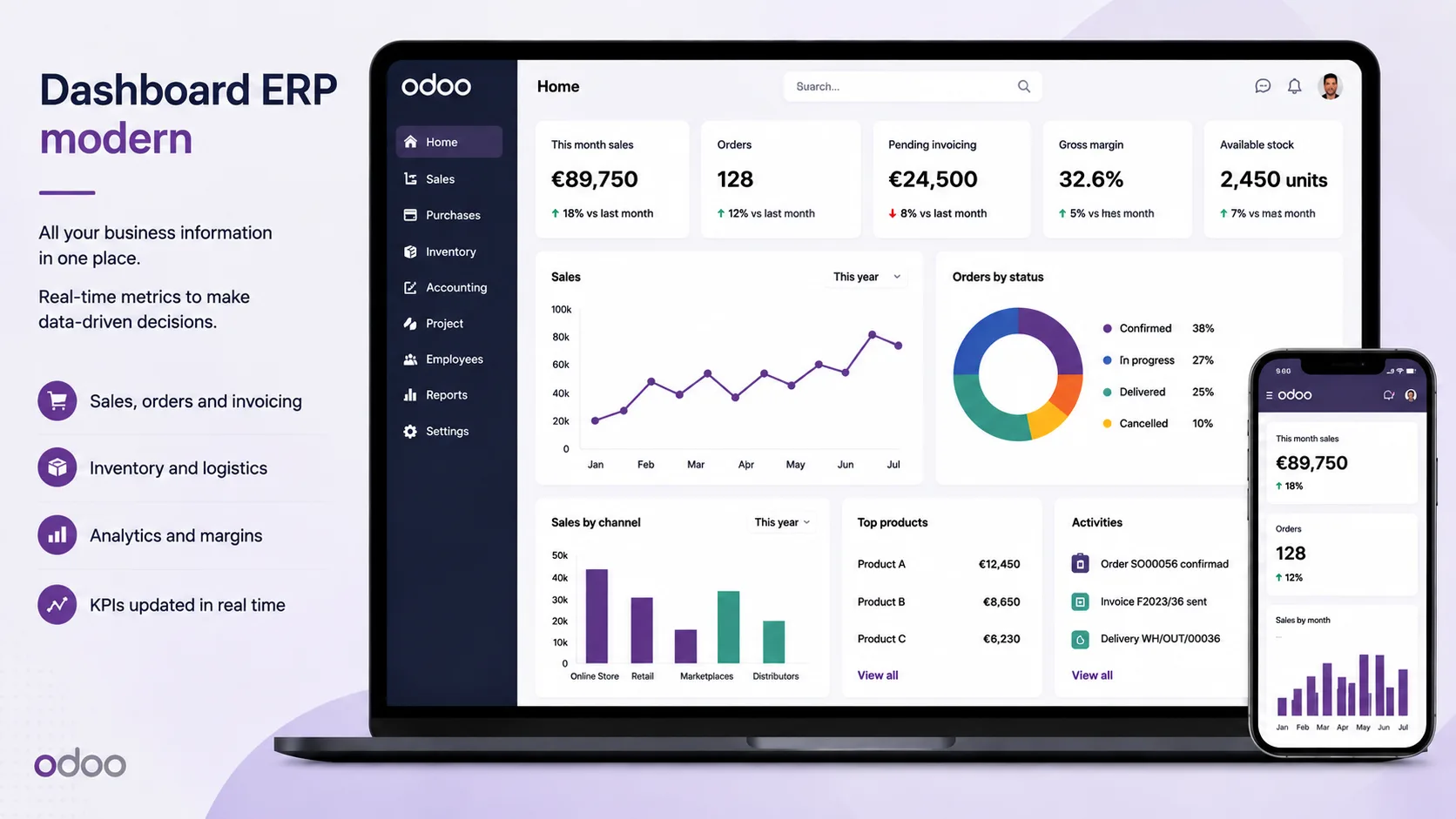
Odoo can be a strong operational foundation when a company needs to centralize processes without building a custom platform from scratch. Its value is not only in the modules, but in organizing sales, purchasing, inventory, accounting, manufacturing and customer service around more consistent data.
ERP works when it stops being a silo and becomes the connected foundation for sales, inventory, invoicing and reporting.
Implementation should start from real processes. Before configuring modules, it is worth identifying which teams are involved, where information is duplicated, where errors appear and which decisions depend on external spreadsheets.
The ERP does not end inside the ERP
The most important work is often integration. A company may sell through Shopify, receive orders from marketplaces, manage warehouse operations externally, invoice with specific tax rules and analyze performance in a BI layer. Odoo has to coexist with that ecosystem and make data ownership clear.
For example, the order may originate in ecommerce, stock may depend on the warehouse, invoices may be generated in Odoo and dashboards may consume consolidated data. Without that distribution, duplicates and manual corrections become part of daily work.
Implementing in phases
A reasonable approach is to start with the processes that condition daily operations: sales, inventory, invoicing, purchasing or customer service. Automations and integrations can then be added progressively. This validates rules with real users, improves master data and avoids an overly broad go-live.
The official Odoo documentation is helpful for understanding modules and capabilities. For integrations, combine Odoo APIs with documented contracts, synchronization jobs and error logs that allow the team to act when something fails.
Signals of a good foundation
A well-integrated Odoo reduces manual work, improves traceability and creates a stronger base for automation. The signals are concrete: fewer parallel spreadsheets, clearer order status, reliable stock, earlier incident detection and business metrics that do not change depending on who exported them.
When ERP is designed as a connected operational platform, not as a closed repository, the company gains room to grow without multiplying administrative work.