
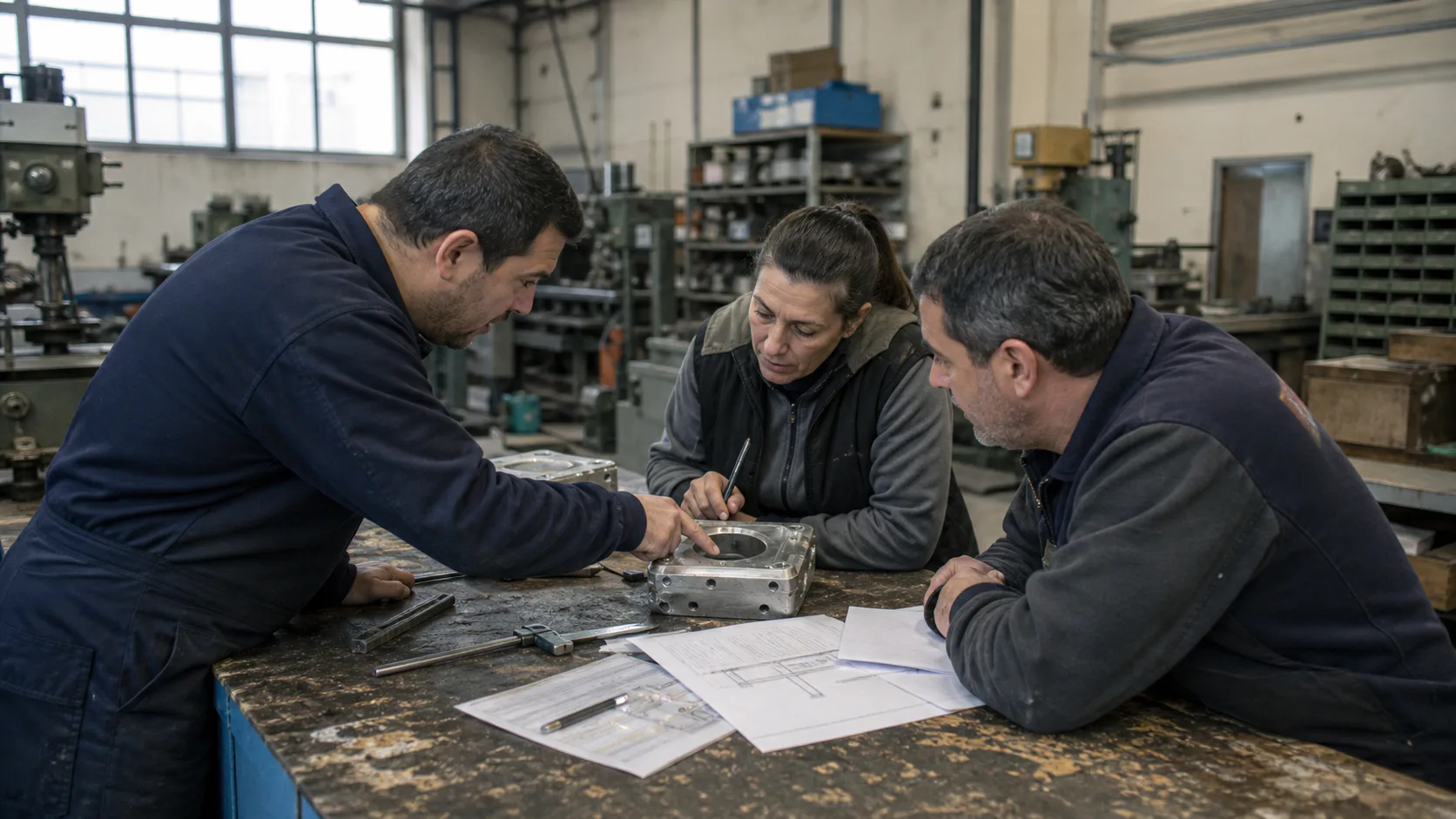
It is easy to leave a conference with a full notebook and return to work feeling that everything should change. Artificial intelligence, automation, new production models, sustainability and talent all open up promising possibilities. Yet on Monday morning, an order is still blocked because one measurement is missing, nobody knows who should approve an exception, and two people are copying the same information into different systems.
A conference can open up valuable questions. Transformation begins when one of them improves the work people actually do on Monday.
That contrast does not diminish the value of professional events. A conference can inspire, connect people and widen their field of view, but it cannot know every exception in each business. Turning an idea into a practical improvement is the responsibility of the people returning to work.
A conference creates questions; it does not solve Monday
The ninth National Industry Congress will take place on 24 and 25 February 2027 at the Niemeyer Centre in Avilés. Organised by Spain’s Ministry of Industry and Tourism, it has been announced under the motto “Movemos Europa”, or “We move Europe”, especially meaningful in an area where industry shapes employment and local identity.
The natural response is to list technologies to investigate. First, it is worth listing the problems to take along: where does the team lose time, which decision arrives late, which task depends on an undocumented shortcut, and which error keeps returning?
Without those questions, every solution sounds attractive. With them, a talk, example or conversation can be tested against an actual need. The difference matters. The company does not return looking for somewhere to install a novelty; it returns with better criteria for deciding whether that novelty is useful.
A composite case: the SME that did not need another tool first
Imagine an SME that manufactures components to order. It misses too many delivery dates, and management believes it needs a predictive system to analyse workload and forecast delays.
Before buying anything, the team follows one family of orders through the business for several days. It finds that the blockage begins well before planning. Some specifications arrive by email, others are copied into an ERP note, and others are clarified over the phone. By the time production discovers that a detail is missing, a delivery date has already been promised. Sales considers the order handed over, planning cannot release it, and production waits. The delay is not invisible. What is missing is a shared rule that defines when an order is genuinely ready to enter the factory.
The company chooses a more modest thirty-day test. It defines the minimum information required at handover, assigns an owner to resolve missing details, and creates a simple alert for incomplete orders. It counts how many orders are blocked, how many handoffs each incident requires, and how long clarification takes. It can then decide whether to automate validation, integrate another source or add predictive capacity.
This is not an argument against technology, but about sequence. Once the process is clarified, any future solution receives a well-defined problem and a measure against which its value can be judged.
Resistance to change can also be useful information
When an implementation struggles, it is convenient to blame people’s resistance. Sometimes there is an understandable preference for familiar routines. At other times, however, the resistance is telling management that the change has been poorly designed.
If an operator keeps a parallel spreadsheet because the new system hides a critical exception, the spreadsheet is not merely a habit to eliminate. It contains information about the process. If the sales team avoids a form because it asks for details they cannot yet know, forcing them to complete it does not improve data quality. It only moves inaccurate data into a tidier screen.
Listening does not mean preserving every private method or deciding by unanimity. Leaders must set objectives and boundaries, but the people doing the work know about friction that rarely appears in a diagram. Eurofound points to the value of phased experimentation supported by employee involvement.
The uncomfortable question is therefore not only “Why are they not adopting the tool?” It is also “What are we asking them to do worse so that our project can appear to be implemented?”
A thirty-day rule for bringing something useful home
Conference ideas compete with daily operations. If every idea becomes an initiative, none receives enough attention. A practical rule is to give one recurring point of friction a thirty-day cycle, producing evidence rather than attempting the company’s entire transformation.
The cycle can be based on five commitments:
- describe one recurring problem without naming a solution yet;
- establish a baseline, even if it requires a manual count for one week;
- involve both the person accountable for the outcome and the people doing the work;
- test the smallest reversible change that can teach the team something;
- review what happened and explicitly choose to continue, adjust or stop.
A polished demonstration may still be wrong for the company’s volume, workforce or process maturity. Stopping a test prevents an intuition from becoming an expensive obligation; a small experiment that works provides a stronger foundation for investment.
From Avilés, Europe can be moved through concrete work
The City Council of Avilés has confirmed the venue and dates in the context of the area’s strong industrial identity. Bringing a national event to the Niemeyer Centre creates an opportunity to connect large conversations with businesses that manufacture, maintain, sell, coordinate and manage exceptions every day.
“We move Europe” can also be understood at that scale. Europe is not moved by major announcements alone. It moves when an SME removes a pointless wait, when a piece of data no longer has to be copied three times, when someone can make a decision with the right context, or when automation removes work without hiding accountability.
At Codefuente, we work in that space between the idea and the operation: first understanding what needs to change, then choosing technology in proportion to the problem. The congress can be an excellent starting point. The real test comes when everyone returns to work.
Which process in your company would remain exactly the same on Monday, even if you were shown the best technology on the market tomorrow?