
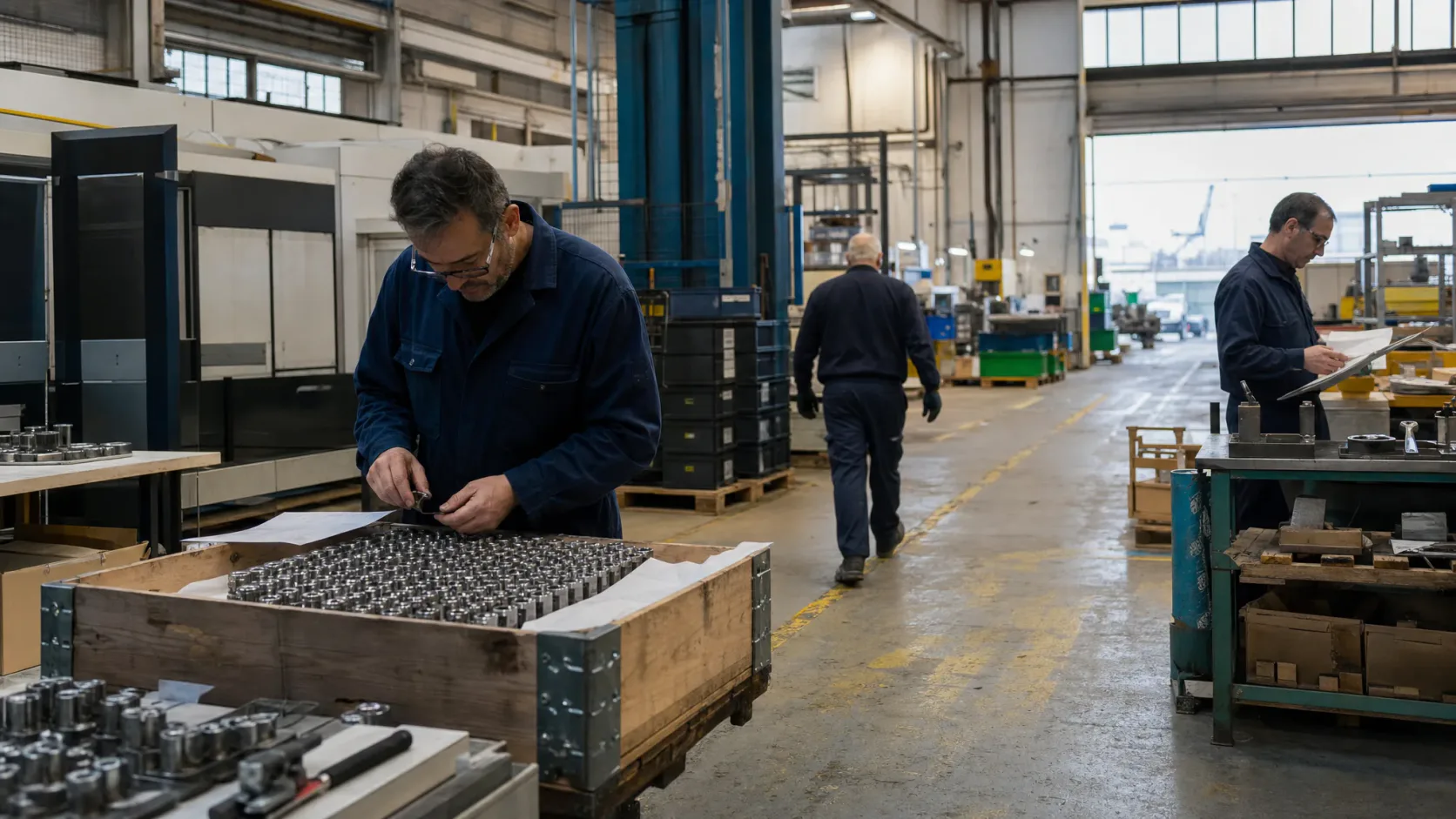
In an industrial unit, the problem rarely starts with a screen. It starts earlier: an order arrives by email, purchasing interprets it one way, production another, and customer service promises a date nobody has validated. When the order is late, everyone blames the system. But the failure is usually coordination.
Productivity is lost not only when work is slow, but when each area makes decisions under different rules.
That is the practical lesson from an industrial ecosystem such as Avilés and its surroundings: it is not enough to have activity, workshops, suppliers and technical talent. What really matters is how the pieces connect in daily work. The value is not in the innovation showcase, but in the ability to solve concrete problems with fewer steps, fewer exceptions and less ambiguity.
What an industrial territory teaches any SME
Industrial territories are often discussed through local pride or nostalgia. For a business, though, the real interest is operational. An industrial environment forces people to think in sequences, tolerances, waiting times, third-party dependencies and handoff errors. Those are the same tensions that appear in a growing services firm, distributor or retailer.
The analogy is straightforward. If in a plant each area uses its own definition of “urgent”, “done” or “ready to ship”, queues, rework and broken promises appear. In an office-based business the same thing happens when sales, operations and finance do not share minimum definitions. It is not a software issue; it is a rules issue.
That is why it is useful to look at a local ecosystem like Avilés and not only at its public announcements. If the region keeps investing in industry, technical training and productive renewal, the question for any leader is more concrete: which part of our daily work still depends on informal conversations because the rule was never defined properly?
The common mistake: confusing activity with coordination
Many companies think growth shows up as more orders, more revenue or more tools. In reality, healthy growth shows up as coordination holding under pressure. When it does not, the signs are predictable:
- managers “fix” the system through chat messages or calls;
- tasks are repeated because nobody fully trusts the previous data;
- the same order passes through too many hands before confirmation;
- small problems stay hidden until they become expensive.
This is where an uncomfortable decision appears: not every process deserves immediate automation. Sometimes the right answer is to remove steps, close variants or assign one owner. Automating a vague process only speeds up confusion.
Mini-case: a supplier business with too many exceptions
Consider a mid-sized subcontracting manufacturer serving several industrial clients with custom orders. Sales teams promised aggressive dates because they could not see the real shop load. Production adjusted priorities at the end of the day according to whoever shouted loudest. The result was predictable: delays, internal calls and an ERP full of statuses nobody truly used.
The improvement did not start with new software. It started with three decisions:
- Define one meaning for “confirmed order”.
- Set one rule for changing priorities.
- Measure how many exceptions entered the system each week and why.
Within weeks, not every problem disappeared, but improvisation dropped. And that changed the conversation from “the system is broken” to “this flow is not closed”.
The uncomfortable decision: simplify, even when it feels less flexible
For many leaders, the hardest part is not digitization. It is giving up the appearance of flexibility. In organizations with a long history, every important customer tends to create an exception: a different format, a different approval, a different shortcut. Add them up and the business looks flexible, but in practice it becomes fragile.
To be clear, there are cases where customization is worth it. But the real question is not whether you can do it. It is whether the company can sustain it without turning every order into a negotiation. A practical criterion is to look at three signals:
- how much time is spent reconciling different versions of reality;
- how many errors come from interpretation rather than execution;
- how many decisions depend on specific people instead of shared rules.
If those signals are high, the problem will not be fixed by more visibility. It will be fixed by reducing variability.
What companies outside Asturias can take from this
Using a place like Avilés as a reference does not mean copying its industrial structure. It means understanding that local competitive advantage often comes less from speeches and more from operational discipline. That is transferable to any business: manufacturing, logistics, technical services, distribution or ecommerce.
The practical lesson is this: before adding another tool, check whether your organization can answer these four questions clearly:
- Who decides when there is conflict between areas?
- Which data is the valid one when versions differ?
- Which exceptions are acceptable and which damage operations?
- Which metric tells you friction has become structural?
If you cannot answer them precisely, you do not yet have a software problem. You have a coordination problem.
At Codefuente, we often come in at exactly that point: when technology should stop adding complexity and start helping the business work with clearer rules and less friction. That is usually the difference between growing and simply accumulating work.