
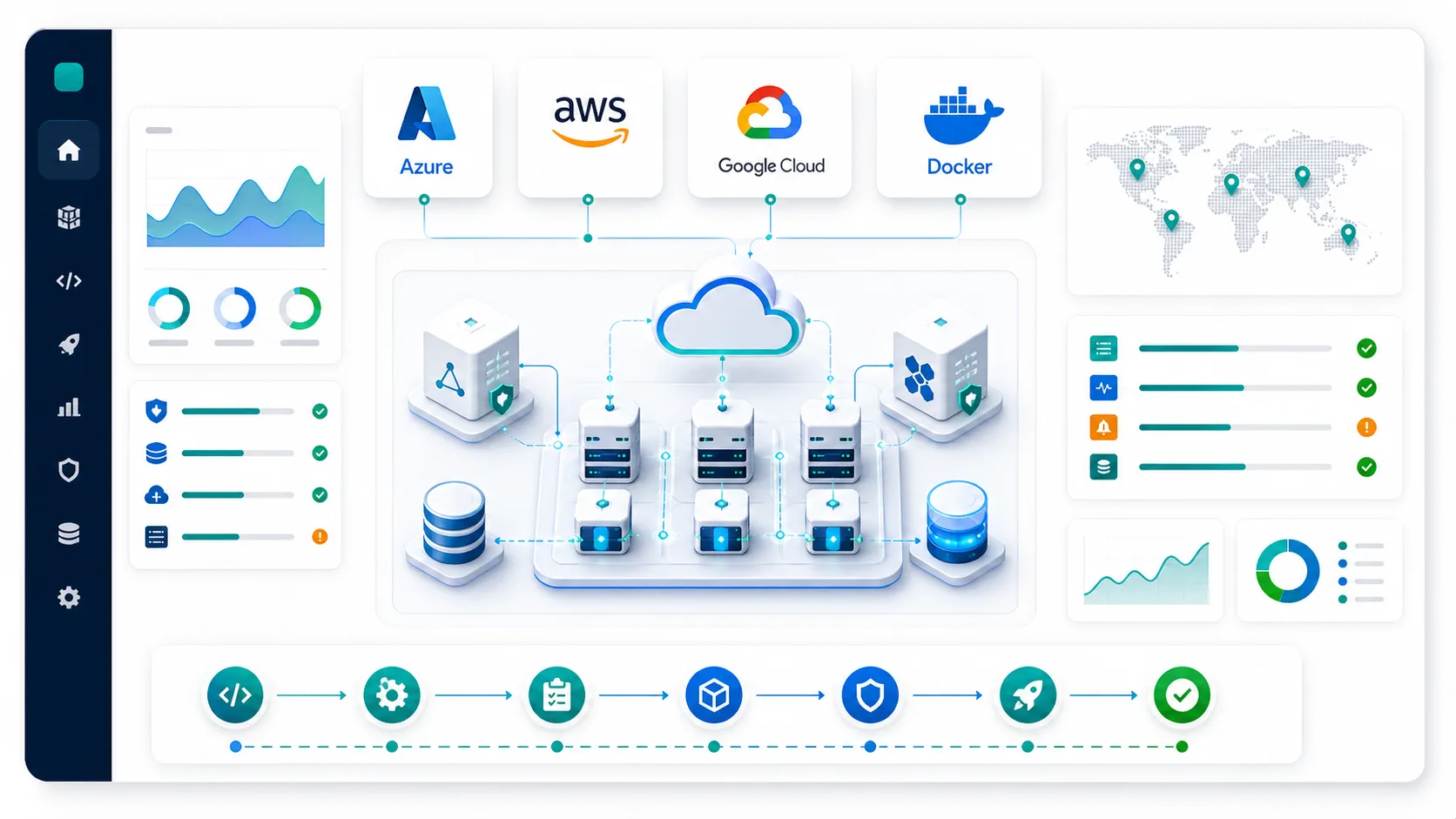
Cloud should not mean unnecessary complexity. For many companies, the goal is more reliable systems, clear backups, repeatable deployments, monitoring and an ordered response to incidents.
Cloud creates value when it reduces uncertainty: repeatable deployments, clear recovery and useful observability.
AWS, Azure and Google Cloud provide powerful services, but their value depends on architecture and daily operation. Separating environments, automating deployments, controlling secrets and observing metrics reduces risk.
Reliability before sophistication
A reasonable cloud foundation starts with simple questions. Where is each application deployed? How is the service recovered after a failure? Which backups are tested? Who receives alerts? Which changes can be made without manually touching production?
Not every company needs Kubernetes, complex architectures or dozens of services. Many need reproducible environments, clear pipelines, centralized logs, useful monitoring and a basic policy for costs and security.
DevOps as daily practice
DevOps is not just a CI/CD tool. It is a way to reduce friction between development, infrastructure and business. Versioning configuration, automating deployments, using variables and secrets correctly, reviewing permissions and measuring performance all prevent recurring incidents.
The AWS Well-Architected Framework and Azure Well-Architected Framework offer useful criteria for reviewing reliability, security, cost, operational excellence and performance. They do not need to become a heavy audit, but they work well as a checklist.
Operating with information
Observability should answer concrete questions: what failed, since when, which users are affected and which change may have caused it. Metrics, logs and traces only create value when the team can interpret them and act.
A well-operated cloud foundation enables more frequent deployments, faster recovery and better decisions. The improvement is not visible in a single screen; it is visible when change stops being a constant source of uncertainty.