
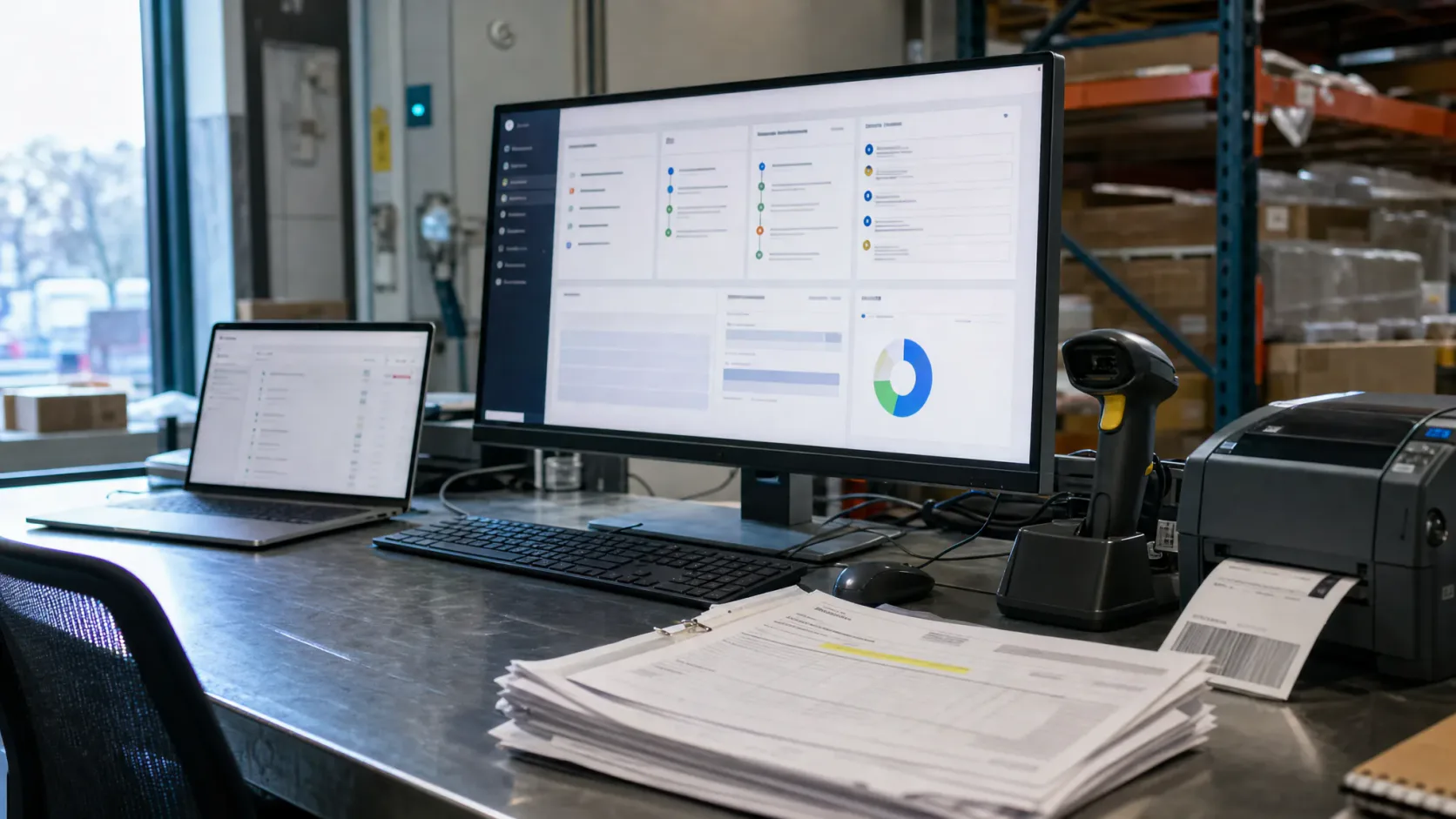
A complaint takes longer than it should when the customer sees one problem and the company sees three separate systems. The email lands in support, the order sits in the ERP, the shipment status lives on a carrier portal and the warranty is buried in a folder nobody opens until tension is already high. That is usually not a technical failure; it is operational friction.
Real improvement does not start with more automation. It starts with less manual searching.
The problem is not replying, it is reconstructing the case
If a customer writes “it arrived damaged” or “one part is missing,” the real job is not to answer quickly. It is to reconstruct which order it belongs to, when it shipped, what actually arrived and which policy applies. That is where many companies lose time: each team optimizes its own slice, but nobody owns the full case.
Leadership often sees a dashboard with “open tickets” and “average response time.” That helps, but it hides the important thing: how many minutes disappear in search, how many messages bounce between teams and how often someone copies the same number into two screens. That wear does not show up on the chart, but it shows up in the team and in the customer.
What AI should do, and what it should not do
The useful way to apply AI here is not to let it “decide” after-sales. It is to use it to read, connect and prepare. In a sensible workflow, the process can look like this:
- Input: an email, form or WhatsApp message arrives with a complaint.
- AI task: the model interprets the text, identifies the likely order, product, date and issue type.
- Business rule: the system checks that against the order, delivery and warranty terms.
- Human approval: a person reviews exceptions, doubts or sensitive cases.
- Output: a draft reply is prepared, or the case is routed with full context.
The key is not to mix three different things. AI interprets language. The system calculates deadlines, amounts or eligibility. The person decides when there is ambiguity, legal risk or a high-value account at stake. That separation avoids false expectations and also prevents automation from turning a small error into a large one.
NIST puts it clearly: its AI Risk Management Framework is voluntary and meant to help organizations manage AI risk during design, deployment and use; its core organizes the work into governing, mapping, measuring and managing risk. That logic fits after-sales very well: define context first, measure next, and only then automate what the business can safely support. (nist.gov)
The uncomfortable mistake: automating too early
The most common mistake is trying to let AI answer everything on day one. It sounds efficient, but it can make operations worse in two ways. First, if the order is not identified correctly, the automated reply can be polite and still wrong. Second, if the team trusts the automatic summary too much, rare cases stop getting reviewed, and that is exactly where losses often hide.
There is another subtle trap: rewarding speed alone. If you only measure “cases closed per hour,” the team will push for fast answers even when the answer is weak. If you also measure rework, escalations and reopened claims, the incentive changes. People stop trying to close tickets and start trying to solve problems.
A small experiment worth running
Picture a distribution SME with complaints arriving by email. There is no need to redesign the whole service. Start with one case type: transport damage with a visible order number.
AI can extract the order number, suggest the item, check whether the delivery was on time and prepare a draft response. If it detects a mismatch — for example, ambiguous order details, a customer with several similar purchases or uncertain warranty coverage — the case moves to a person with the full context already assembled. That does not remove human judgment; it makes it faster and more consistent.
The value is not only answering sooner. It is reducing search time, lowering assignment errors and preventing the customer from repeating the same story three times. If sales, logistics and support all work from the same case record, the conversation changes: it stops being “who had it?” and becomes “what do we do now?”
What to measure to know if it works
You do not need a large program to validate the idea. Three concrete signals are enough:
- time to find the correct order;
- time to the first useful response;
- percentage of cases AI routes to a person because of real uncertainty, not poor design.
If those three numbers improve, the experiment is promising. If response time drops but corrections and frustration increase, the savings were only apparent.
The best question is not “can we use AI in after-sales?” The useful question is: can we stop making the customer explain the same problem to three departments? That is the friction dashboards usually hide.
Three actions for this week:
- Choose one complaint category and map its real path across email, ERP and delivery.
- Decide what AI may interpret and which exception must be approved by a person.
- Measure one week of time lost searching for data before you automate anything else.
If you want to start with a small, reversible pilot, Codefuente can help you design it without turning it into a heavy program.